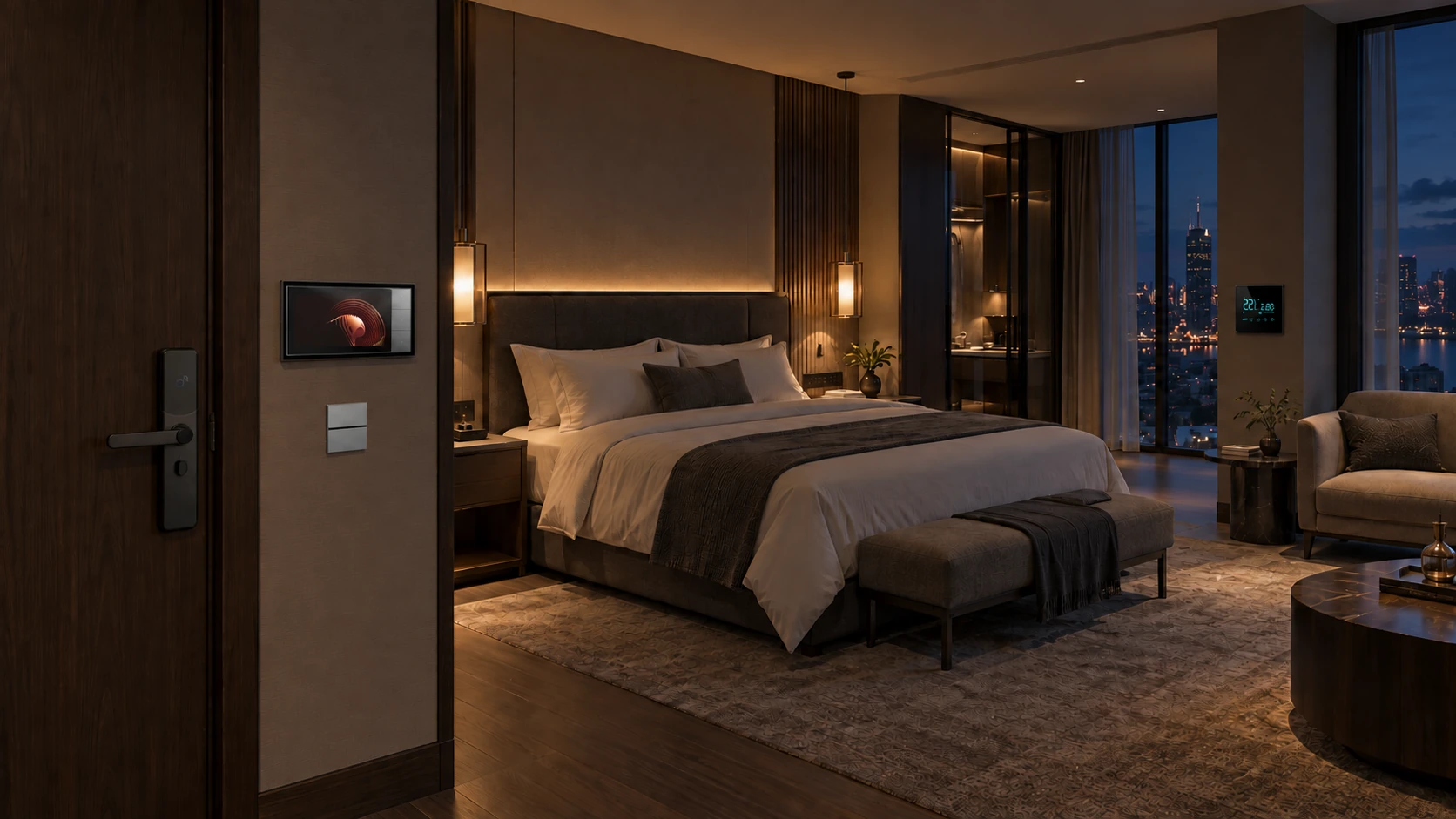
A better stay.A room that responds.

Guest access, intuitive room controls and occupancy-based energy management, specified for your hotel.

Compare configurations

Experience the space.

Discover the products behind the experience.
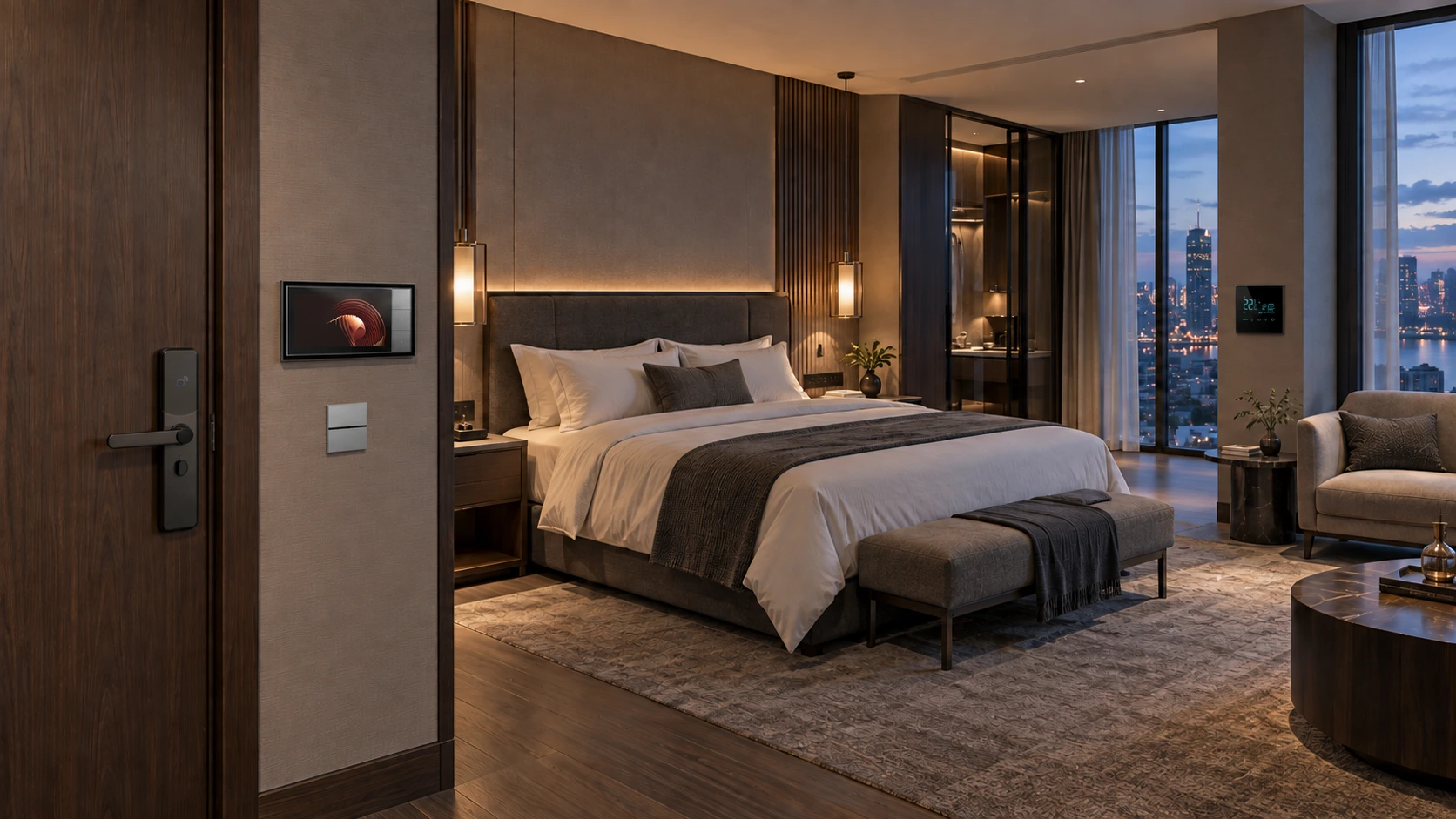
Illustrative hotel suite with wall-mounted LEONDARX product references
Hotels & serviced apartmentsApplication concept

Explore the guest arrival setting. Hotel access and room controls are specified as separate systems.

Illustrative application scene. Product configuration, functions and final appearance depend on the selected models.

A familiar guest experience

Local controls for lighting, comfort and a quieter night.

Address empty-room waste

Evaluate door-state and occupancy logic instead of relying only on card removal.

Test once, then repeat

Agree one reference room before reproducing the configuration.

Make the room intuitivefrom the first night.

Guests should find the controls they need without a room-control lesson.

Unclear lighting groups, scattered controls and confusing service requests create friction for guests and extra explanations for staff.

Plan the guest journey from access to the bedside. A conventional room scope can combine the selected lock system, card-operated power, local lighting and optional curtains, temperature control or doorbell/status panels.

Illustrative room configuration. Consult the original room plan when reviewing device positions.
Illustrative application of matching status panels. Confirm the supplied panel functions and revision.

Arrival and access

Choose the credential and front-desk workflow with the lock platform. Room authorisation and card-operated power are different functions.

Rest and comfort

Group selected lighting actions at an obvious control position. Specify curtain and HVAC interfaces when these functions are included.

Privacy and service

Evaluate matching doorbell/status panels for Do Not Disturb and service requests. Confirm the exact panel behaviour and room numbering.

A coherent guest experience begins with a defined set of room functions, rather than every available device.

An empty room should notlook occupied to the system.

A card left in the slot can keep selected equipment powered after departure.

Card-operated power reacts to the card, which is not always a reliable indication that a guest is still using the room. At the same time, energy control must protect sleeping guests and bathroom use.

The ECO reference combines door-state information, PIR sensing and configured delay logic to assess room use. Start with an occupancy-control scope on its own, then add room-control functions only where they are needed.

Occupancy concept, not a control sequence or saving claim. The original diagram provides the reference logic.
Sensor-placement concept. Coverage and controller configuration require a project-specific review.

Read the room state

Specify the matching controller, door contact and sensor coverage. A motion detector alone does not define the complete occupancy sequence.

Protect comfort and essentials

Test sleeping, bathroom, housekeeping and multiple-guest scenarios. Identify network equipment and other circuits that must remain powered.

Measure the opportunity

Use actual controlled loads, avoidable run hours and the local energy tariff. Compare the sample-room result before estimating a wider benefit.

Evaluate avoidable empty-room consumption without promising a fixed percentage or compromising occupied-room comfort.

One approved roombefore a hotel-wide rollout.

A repeatable configuration needs both operational and installation checks.

A lock may suit the door while its software does not suit reception. A room-control gateway may be mistaken for a lock gateway. Repeating either mismatch across many rooms makes maintenance harder.

Agree the systems separately, then verify the complete guest journey in one representative room. For European locations, start with local electrical conditions, wall boxes, door preparation and the hotel’s installation window.

Company material used for project coordination. No completed hotel installation or measured result is implied.

Separate the system decisions

Identify lock platform, encoder/credentials, room-control architecture and ECO scope. Treat PMS or cross-system links as an explicit integration requirement.

Validate the actual room

Test the door and lock fit, lighting loads, HVAC interface, network coverage and outage behaviour. Include reception and housekeeping in acceptance.

Define the handover

Agree room/device records, installation drawings, operator training and support responsibilities. Keep the approved configuration under version control for repeated rooms.

Send room types, room count, country, door details and your desired functions to begin the sample-room discussion.

Solution image detail

Two useful starting points.

Choose the scope first. We help define the equipment, installation and handover.

01

Everyday room control

Plan guest access, card-operated power, lighting and selected comfort controls.

Doorbell/status panels, curtains and central screens are optional additions.
02

ECO occupancy control

Use matching door and motion sensing to evaluate when selected loads are needed.

Start with energy control alone. Validate sleep, bathroom use and multi-guest occupancy.

Make it work
for your market.

For European projects, start with the installation and installer. Keep the customer experience simple.

Protect guest comfort

Test occupied, sleeping, bathroom, housekeeping and second-guest scenarios in one sample room.

Keep essentials powered

Identify circuits that must stay on and agree the controlled-load and HVAC scope.

Fit your operation

Check door/lock dimensions, local wall boxes and power, network availability and the exact PMS/interface scope.

Technical questions & scope

Can I start with energy control only?

Yes. Discuss a matching ECO controller, door contact and motion-sensing configuration. Full room control and a connected lock are separate options. The supplied catalogues have conflicting ECO model revisions; the actual controller and sensor set must be confirmed.

Does one gateway connect everything?

No. Lock gateways and room-control gateways have different roles. Specify the lock platform, room-control system and any project-specific link independently. A product named G2 is not enough to establish its role or compatibility.

What energy saving should we expect?

Measure the controlled load, avoidable run hours and your local tariff in a sample room. We do not turn the catalogue’s illustrative scenarios into a guaranteed electricity-saving percentage.

This is an illustrative room configuration. Lock access and room controls are separate systems; a common gateway, PMS link or automatic cross-system trigger is not assumed. ECO behavior and essential circuits require sample-room testing.

Catalogues & manuals ↗
01

Prepare

Share a floor plan, country and the functions you need.

02

Prove

Agree the equipment and verify one room or sample area.

03

Deliver

Choose preconfiguration, installer training and commissioning support.

Start with one
well-planned space.

Send your country, floor plan and required functions. We will help define the next step.

Request a room configuration